
Team of Prof. Wei‑Xing (Xing Wei), Changchun Institute of Applied Chemistry, CAS: Unraveling the Potential‑Dependent Degradation Mechanism of Fe‑N‑C Catalysts for Oxygen Reduction Reaction
DOI:https://doi.org/10.1007/s11426-024-2359-9
Fe‑N‑C catalysts, featuring excellent catalytic activity and low‑cost raw materials, are regarded as one of the most promising candidates to replace platinum‑based catalysts for proton‑exchange‑membrane fuel cells (PEMFCs). Nevertheless, the insufficient understanding of their degradation mechanisms and poor long‑term performance durability have become major bottlenecks hindering their industrial translation.
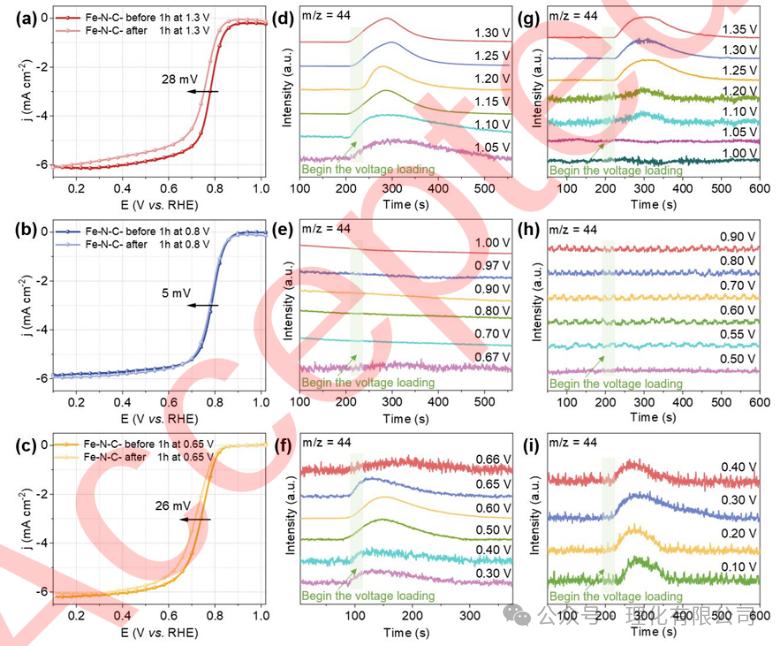
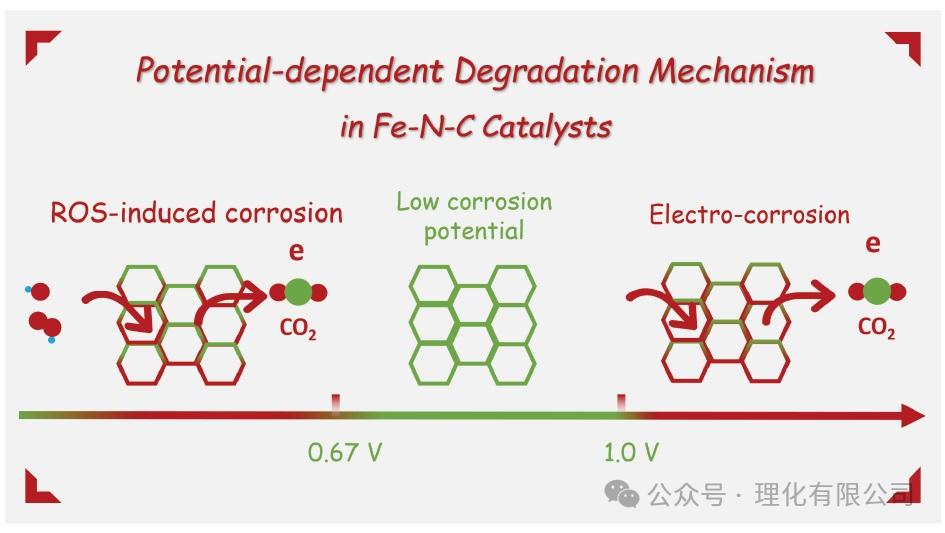
Recently, the research group led by Professor Wei Xing at the Changchun Institute of Applied Chemistry, Chinese Academy of Sciences, has had their manuscript entitled Unraveling the Potential‑dependent Degradation Mechanism in Fe‑N‑C Catalysts for Oxygen Reduction Reaction accepted for publication in SCIENCE CHINA Chemistry (JCR Q1). In this work, real‑time evolution of the electrode during oxygen reduction reaction (ORR) was monitored, and the intrinsic potential‑dependent degradation mechanism of Fe‑N‑C catalysts was uncovered. Three distinct potential regions with different degrees of performance decay were identified by means of in‑situ differential electrochemical mass spectrometry. Notably, carbon‑corrosion signals were detected at low potentials. Combined with theoretical calculations and fluorescence‑probe experiments, it was verified that degradation under high potentials is mainly triggered by strong oxidative potentials which overcome the energy barrier for carbon oxidation, while degradation at low potentials originates predominantly from high‑concentration reactive oxygen species (ROS) generated during the ORR process. This study provides comprehensive insights into the internal correlation among multiple degradation pathways and offers new strategies to improve the durability of Fe‑N‑C catalysts for practical PEMFC applications.
Background
Driven by the rapid development of hydrogen‑energy industry in China, developing novel non‑platinum‑group‑metal (non‑PGM) catalysts to substitute costly platinum benchmarks is of great significance for addressing cost and sustainability issues of proton‑exchange‑membrane fuel cells (PEMFCs). Among all reported candidate materials, atomically dispersed Fe‑N‑C catalysts with iron‑nitrogen coordination sites stand out owing to their outstanding initial ORR activity in acidic electrolytes. However, Fe‑N‑C catalysts commonly suffer from unsatisfactory stability and gradual performance loss. In this study, a DC‑DSR digital rotating ring‑disk electrode (supplied by PHYCHEMI (Hong Kong) Co., Limited) was employed to explore the degradation behavior of Fe‑N‑C catalysts in acidic media. This work sheds light on the potential‑related interplay between different degradation pathways and carries important guiding value for future catalyst design.