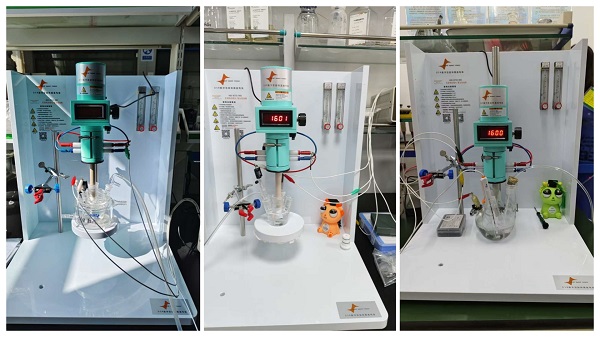

DSR Rotating Ring‑Disk Electrode Apparatus
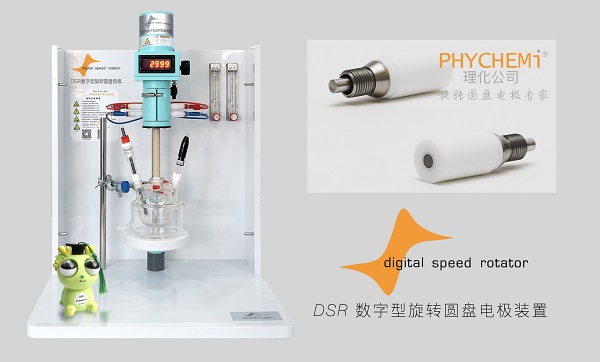
DSR Digital Rotating Ring‑Disk Electrode
Technical Specifications
- Rotation speed: 0‑10000 rpm, motor power: 20 W.
- Carbon brush: Eco‑friendly silver‑carbon brush is adopted for contact connection, enabling nearly loss‑free signal transmission.
- Control: Integrated control design with compact size; detachable structure, convenient for placement inside a glove‑box; digital control chip ensures highly‑accurate rotation speed; DC power supply reduces mains‑derived noise interference to the main unit and delivers strong anti‑interference performance.
- Equipped with a signal‑input port. The rotation speed can be controlled via external signals from devices such as an electrochemical workstation.
- Explosion‑proof: Adopts the latest explosion‑proof design to guarantee safety of operators and equipment.
- Shaft: Length 170 mm, outer diameter 15 mm. Compatible with a wide range of electrolytic cells and easy to couple with other instruments. Shafts of alternative models are also available for diverse research applications.
- Disk electrode: External‑thread design ensures superior contact and stable signal transmission. Working material: glassy carbon. Two housing materials are optional: Teflon and PEEK. Electrode diameter: 5.0 mm; outer diameter: 15 mm. Operable from room temperature to elevated temperatures.
- Ring‑disk electrode: External‑thread design provides improved contact and stable signal transmission. Teflon and PEEK housing materials are optional for different applications. Gap between disk and ring ≤ 320 μm. Dimensional accuracy of disk‑ring: 0.01 mm. Disk diameter: 5.61 mm; ring inner diameter: 6.25 mm; ring outer diameter: 7.92 mm. Electrode collection efficiency: 37 %.
- Electrolytic cell: Users may select a standard five‑neck electrolytic cell or customize their own cell.
The following charts are plotted based on customer‑supplied data to demonstrate performance with factual results.
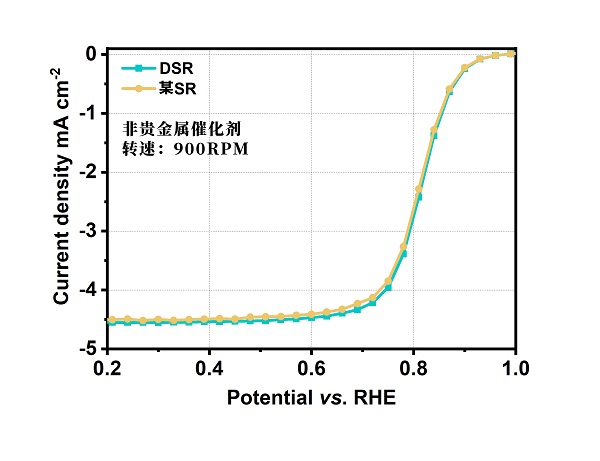
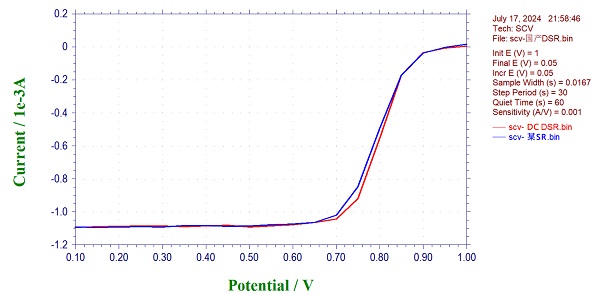
- The onset potential of DCDSR is basically consistent with that of a certain SR, indicating that their responses are nearly identical at the initial stage of the electrochemical reaction.
- DCDSR exhibits a higher half‑wave potential, which signifies that its tested performance outperforms that of a certain SR.
- The limiting current densities are roughly equivalent, demonstrating similar mass‑transfer efficiency and nearly consistent responses when handling current of the same magnitude.
Typical Applications of DSR Digital Rotating Ring‑Disk Electrode
When coupled with working electrodes and an electrochemical workstation, the DSR rotating ring‑disk electrode fulfills diverse scientific‑research experimental requirements. It is applicable to:
- Research and evaluation of hydrogen‑fuel‑cell catalysts
- Lithium‑air battery research
- Electrochemical kinetics research
- Oxygen Reduction Reaction (ORR) research
- Oxygen Evolution Reaction (OER) research
- Hydrogen Evolution Reaction (HER) research
- Carbon Dioxide Reduction Reaction (CO₂RR) research
- Corrosion inhibitor evaluation and research
- Corrosion‑potential research of metallic materials, etc.